Slow part retrieval, misplaced inventory, and wasted floor space—if you manage a parts department, these frustrations are probably all too familiar. They're not just minor annoyances; they're direct hits to your bottom line.
The fix? Strategic pallet racking for parts departments. This is about transforming simple shelving into a high-performance asset that moves your operation from chaotic to streamlined, boosting both efficiency and control.
The Strategic Role of Pallet Racking in a Parts Department
Staring at a disorganized parts room is a familiar headache for any manager. But what looks like simple clutter is actually a significant operational drag. Every minute a technician spends hunting for a component is a minute not spent on a revenue-generating repair. That lost time adds up fast, leading to slower service, frustrated employees, and leaking profits.
The root of the problem usually isn't a lack of space. It's the lack of an effective storage strategy.
This is where a thoughtful system of industrial pallet racking becomes a true game-changer. It's so much more than just a place to put things; it's the foundational structure that dictates your department's workflow and, ultimately, its productivity. By implementing the right solution, you create a logical, accessible, and safe environment for your entire inventory.
From Chaos to Control
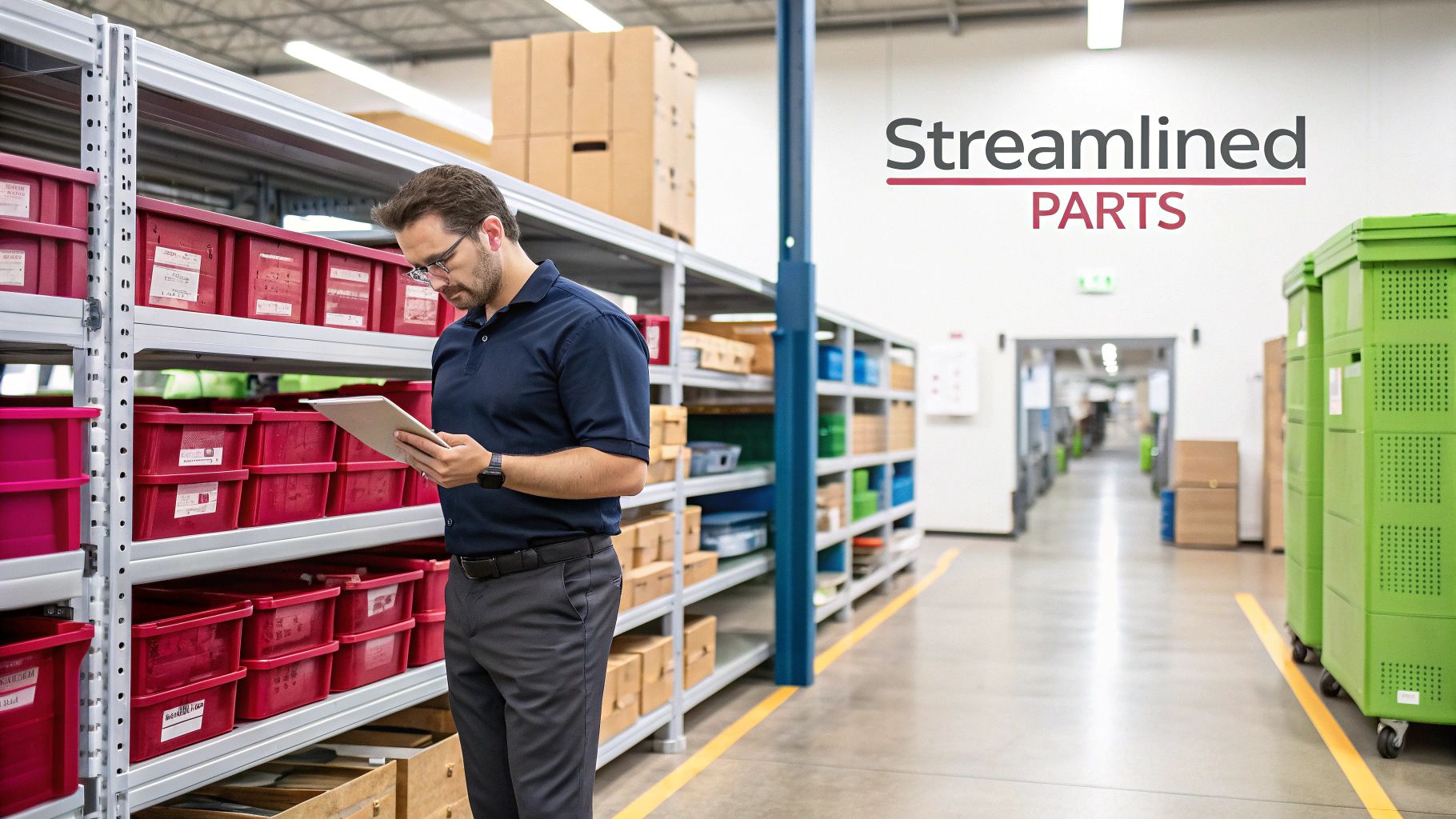
An optimized racking layout brings order and predictability to the floor. Instead of a free-for-all, every single part has a designated, labeled home, making retrieval fast and dead accurate. This systematic approach pays off immediately in several ways:
- Improved Inventory Accuracy: When every item has a specific spot, tracking stock levels becomes drastically simpler. You can finally get a handle on your inventory, reducing the risk of overstocking or running out of a critical part right when you need it.
- Enhanced Productivity: Technicians and parts pullers can find and grab what they need in a fraction of the time. This directly speeds up service and fulfillment, getting jobs out the door faster.
- Maximized Space Utilization: Pallet racking is all about using your vertical space. You can effectively multiply your storage capacity without the massive expense of expanding your physical footprint.
- Increased Workplace Safety: A clean, organized space with clearly defined aisles isn't just efficient—it's safe. It dramatically cuts down on the risk of trips, falls, and other accidents caused by clutter.
A Foundation for Growth
Putting in a robust pallet racking system is a forward-thinking investment. As parts departments are forced to handle an ever-expanding range of SKUs—from tiny fasteners to bulky body panels—a scalable storage solution becomes essential. This is especially true in the automotive sector, where the sheer variety of components is standard.
If you're in that world, you can dive deeper by checking out our comprehensive guide to storing auto parts, which outlines specific strategies for that industry's unique challenges.
Ultimately, the goal is to create an environment that supports your team and helps you hit your operational targets. Getting the layout and system design right from the start is absolutely critical. By planning for future needs and truly understanding the unique flow of your department, you ensure your investment pays dividends for years to come. With project timelines for installations often extending further out due to high demand, starting the planning process now gets your business in the queue and helps you avoid costly delays down the road.
How to Choose the Right Racking System for Your Parts
Not all parts are created equal, and neither are your storage options. Picking the right pallet racking for a parts department isn't a one-size-fits-all job; it’s about matching the system to the unique rhythm and makeup of your inventory. The real goal is to strike that perfect balance between storage density (how much stuff you can cram in) and accessibility (how fast you can get to it).
Making the wrong choice can create operational headaches and frustrating bottlenecks down the line. But the right system? That can unlock some serious efficiency gains. The whole decision hinges on a clear-eyed look at your specific parts mix, from the tiniest fasteners to the bulkiest engine components.
Analyzing Your Parts Inventory Profile
Before you even think about rack types, you have to get intimate with what you're actually storing. A detailed inventory analysis isn't just a good idea—it's the most critical first step. You need to look at your inventory through three specific lenses:
- Size and Weight: Are you storing heavy engine blocks on pallets or small, lightweight sensors in bins? The physical dimensions and weight of your parts directly dictate the beam capacity and shelf type you’ll need.
- SKU Diversity: How many different part numbers are you dealing with? A department juggling thousands of unique SKUs has vastly different needs than one with a few hundred high-volume items.
- Turnover Velocity: Which parts fly off the shelves, and which ones sit for a while? Identifying your high, medium, and low-velocity items is the key to designing an intelligent layout that puts the most popular parts in the easiest-to-reach spots.
This analysis gives you the hard data you need to compare different systems. Without it, you’re just guessing.
For parts departments, where immediate access to a massive variety of SKUs is the name of the game, the ability to grab any part without moving another is a huge advantage. This is why 100% selectivity is often the most important feature you can have.
Comparing Common Racking Systems
With your inventory profile in hand, you can start evaluating the most common types of pallet racking. Each one offers a different trade-off between how much you can store and how easily you can access it. In the world of parts, where getting your hands on a specific component right now is king, one system has proven its worth time and time again.
In fact, the selective pallet rack segment commanded more than one-fourth of the global warehouse racking market revenue in 2022, and for good reason. Parts departments thrive on quick access to a diverse mix of components, and selective racks deliver that access like no other.
The table below breaks down the top contenders for a parts department setting, helping you see the pros and cons at a glance.
Comparing Pallet Racking Systems for Parts Departments
This table compares key features of different pallet racking types to help you choose the best system for your specific parts storage needs.
| Racking Type | Best For | Storage Density | Accessibility (Selectivity) | Inventory Rotation |
|---|---|---|---|---|
| Selective Rack | Diverse, low-volume SKUs; high selectivity needs | Low to Medium | 100% | Excellent (FIFO) |
| Push Back Rack | Medium SKU count; moderate turnover | High | Good (LIFO) | Fair (LIFO) |
| Drive-In Rack | High volume of identical SKUs; low turnover | Very High | Low (LIFO) | Poor (LIFO) |
| Pallet Flow Rack | High volume of fast-moving SKUs | Very High | Excellent (FIFO) | Excellent (FIFO) |
For a more in-depth exploration of these and other systems, our comprehensive guide to selecting pallet rack for your warehouse is a great next step.
Matching the System to Your Needs
For most parts departments, Selective Pallet Racking is the clear winner. Its simple, open design allows forklift operators to access any pallet, at any time, without moving anything else out of the way. This is absolutely essential when you need to pull one specific part without delay. It’s the most versatile and straightforward system, making it perfect for the varied inventory you see in automotive and manufacturing settings.
That said, high-density systems can definitely have their place. If you store huge quantities of the same fast-moving part—like cases of oil filters or stacks of tires—a Pallet Flow or Push Back system in a dedicated zone can dramatically increase your storage capacity for those specific items.
Ultimately, the best solution might be a hybrid approach. You could use Selective racking for the bulk of your diverse inventory and then create a high-density zone for your highest-volume, uniform products. This kind of customized strategy maximizes both your space and your team's efficiency.
The complexities of designing such a layout are why so many managers seek expert guidance. With demand for quality racking and professional installation on the rise, getting your project into the planning stage sooner rather than later helps secure your place on the schedule. Contact us today to start a free, no-obligation design and see how a tailored system can work for you.
Designing a High-Performance Parts Department Layout
An effective parts department is more than just strong racks; it’s a living, breathing ecosystem. The strategic layout of your storage area dictates the entire workflow of your operation, directly impacting how quickly parts are received, stored, and ultimately picked for an order.
A thoughtful design transforms your floor space from a simple holding area into a high-performance engine for your business. It’s about creating a seamless path from the receiving dock to the shipping area, not just dropping racks into rows. Getting fundamentals like aisle width, task zones, and picking ergonomics right from the start prevents costly mistakes and frustrating redesigns down the line.
Mapping the Ideal Product Flow
The first step is always to map the journey a part takes through your facility. Think of it like planning a city's road system to avoid traffic jams. You want the most direct and logical route possible for every single item, from the moment it arrives to the moment it leaves.
This journey typically breaks down into a few key stages:
- Receiving: A dedicated area for unloading trucks, inspecting shipments for accuracy and damage, and prepping items for storage.
- Staging: A temporary zone where received parts are sorted and organized before being put away into their final rack locations.
- Storage: The main racking area, organized by a logical system (like SKU velocity, part type, or size) to make finding things intuitive.
- Picking: The process of pulling parts from storage to fulfill a service request or customer order. Your layout should make this as fast as humanly possible.
- Packing and Shipping: The outbound area where picked parts are prepared, boxed up, and staged for pickup or delivery.
By creating distinct, yet connected, zones for each of these functions, you eliminate cross-traffic and cut down on the number of steps your team needs to take. It's the foundation of an efficient parts operation.
Aisle Width and Accessibility
One of the most critical decisions you'll make is setting your aisle width. This is a delicate balancing act between maximizing every square foot for storage and ensuring your team and equipment can move safely and efficiently.
Get it too narrow, and you create a safety hazard and a frustrating bottleneck for forklifts. Make it too wide, and you’re just wasting valuable real estate that could be holding more inventory. The right width depends entirely on the material handling equipment you use.
For instance, a standard counterbalance forklift might demand aisles of 12 feet or more, while a nimble narrow aisle reach truck can operate comfortably in aisles as slim as 8 to 9 feet. Documenting your equipment's turning radius and specs is a non-negotiable step before you finalize any layout.
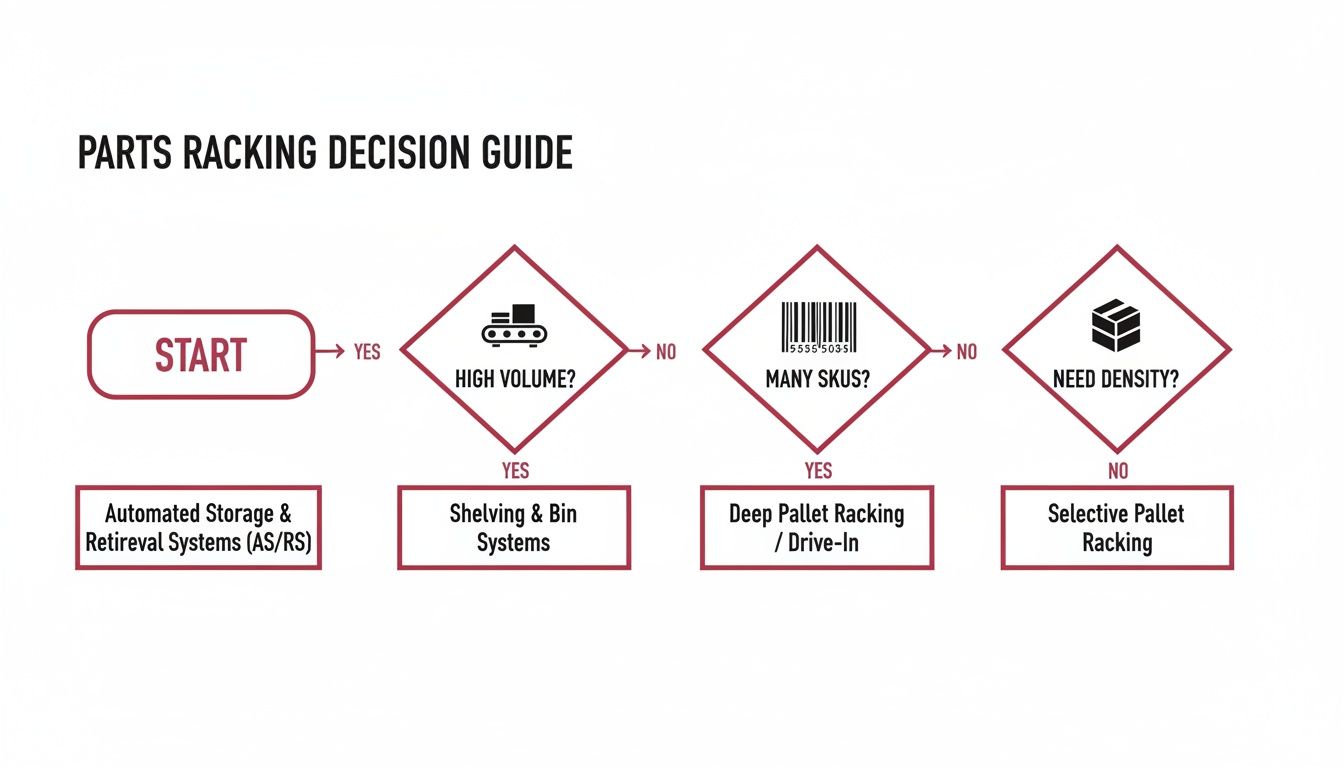
This decision tree helps visualize how factors like your inventory volume and SKU count should guide your choice of racking and overall layout density. The key takeaway? There's no single "best" layout—the optimal design is always a direct response to your specific operational DNA.
Maximizing Vertical Space
Your building's clear ceiling height is one of your greatest, and often most underused, assets. Going vertical with tall pallet racking is the most cost-effective way to boost storage capacity without needing to expand your footprint. Integrating multi-level systems like mezzanines can effectively double or even triple your usable floor space.
This "build up, not out" strategy is especially powerful in North America, a true powerhouse in the pallet racking market, capturing a massive 36-37% global market share. This leadership, built on decades of innovation since the post-WWII industrial boom, means facility managers have access to incredibly advanced systems. You aren't just stuck with basic racks; you can blend them with solutions like modular buildings for a truly secure and scalable setup.
Integrating Racking with Your Operations
Your pallet racking system doesn't exist in a vacuum. It has to work in harmony with all the other essential equipment to create a cohesive workspace. This means planning for the placement of:
- Workbenches and Packing Stations: Position these near your picking and shipping zones to slash travel time for your staff.
- Conveyors: For high-volume operations, conveyors can automate the movement of parts from storage areas to packing stations, doing the heavy lifting for you.
- Charging Stations: Forklift charging areas need a strategic home where they won’t obstruct the main traffic arteries of your warehouse.
Thinking about these integrations early in the design phase is crucial. A well-integrated layout ensures every piece of the puzzle works together, preventing workflow interruptions and squeezing every last drop of productivity out of your operation.
The complexity of these layouts, especially in specialized environments, often requires an expert eye. For a deeper look into the nuances, you can learn more about our specialized automotive parts room design services. Planning your layout with an expert from day one provides actionable insights and prevents costly missteps.
Understanding Load Capacity and Safety Essentials
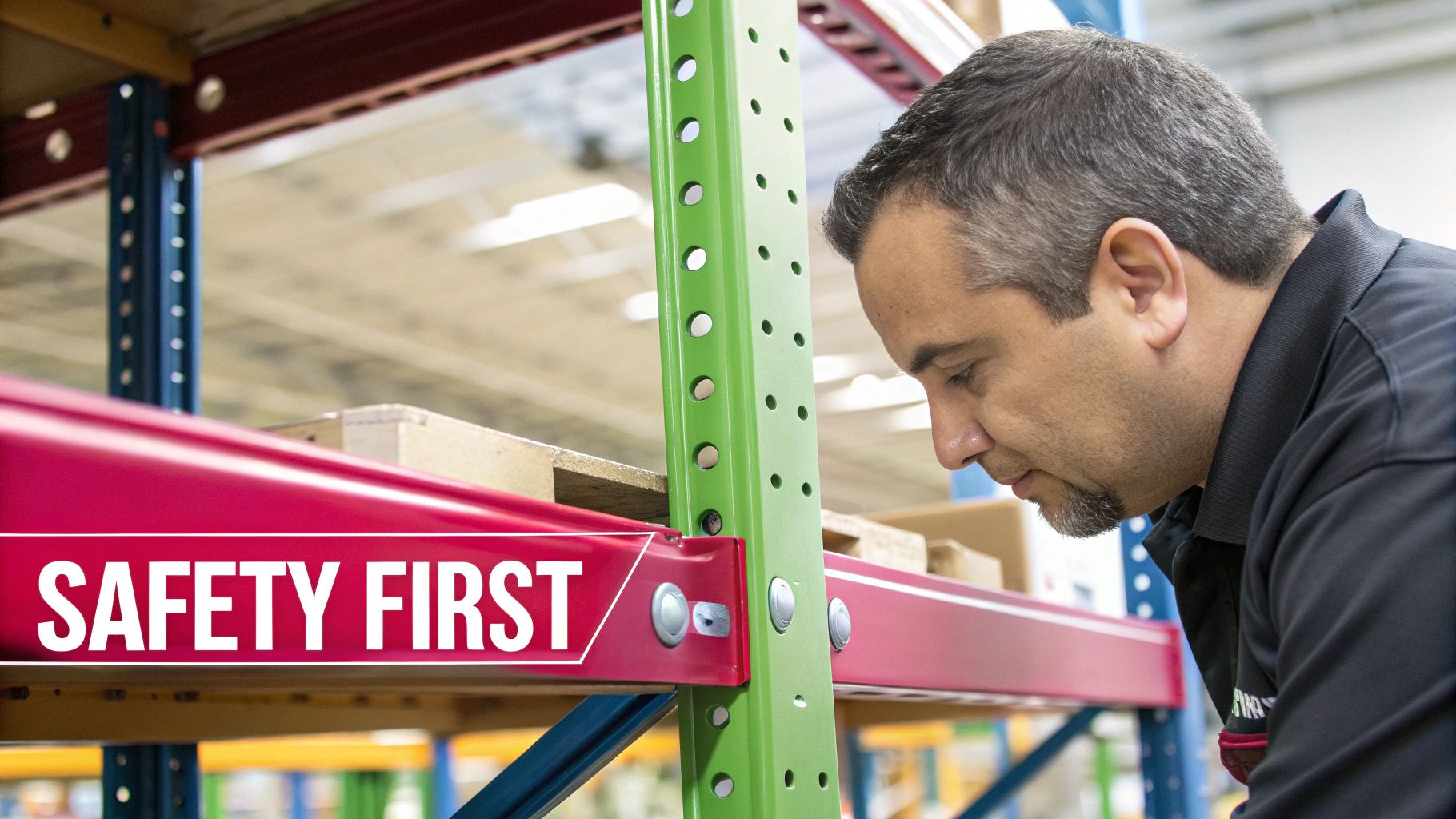
In a busy parts department, safety is the one area where there’s zero room for compromise. Let's be blunt: overlooking the fundamentals of load capacity and proper installation doesn't just put your inventory at risk; it endangers your team. A solid, secure pallet racking for parts departments system is built on one thing: understanding and respecting its limits.
This is more than a box to check for compliance. It’s about creating a stable, predictable environment where your people can work efficiently without giving a second thought to the rack's integrity. From the steel beams to the concrete anchors holding it all down, every single component has a critical job to do.
Decoding Load Capacity Ratings
Every piece of a pallet rack system—from the horizontal beams to the vertical upright frames—has a specific, engineered load capacity. This isn't a suggestion. It's a hard limit, and exceeding these ratings is the number one cause of catastrophic rack failure.
- Beam Capacity: This number tells you the maximum weight a pair of beams can hold. The key here is that it's for an evenly distributed load. A heavy engine block dropped in the center of a beam can cause it to fail, even if the total weight is technically under its rating.
- Upright Capacity: This one is a bit more complex. The upright frame's capacity actually changes based on the vertical distance between your beam levels (what we call the "unsupported span"). The farther apart your beams are, the less weight the overall frame can handle.
Here's the critical takeaway: you can't just add up the capacity of all your beams to figure out what a bay can hold. The upright frame's rating is always the ultimate limiting factor. Our team can help you run these crucial calculations during a free pallet rack design services consultation.
The Non-Negotiable Role of Professional Installation
Some racking systems look simple enough, but proper installation is a technical job that demands precision. It's the only way to guarantee the system is perfectly plumb, level, and securely anchored to the floor—all of which are essential for it to meet its stated load capacity and safety standards.
Professional installation is your best insurance against common mistakes like bad anchoring or misaligned components. With skilled installers in high demand, scheduling this service early in your project is a smart move that prevents delays and gets your system up and running safely.
Essential Safety Accessories
Beyond the basic frame and beams, a few key accessories dramatically boost the safety and stability of your system. Think of these as standard safety equipment, not optional extras.
| Safety Accessory | Primary Function | Why It's Crucial for Parts Departments |
|---|---|---|
| Wire Decking | Provides a flat, stable surface on beams and prevents items from falling through. | Perfect for storing smaller boxes, bins, or non-palletized parts that don't sit securely on beams alone. |
| Pallet Supports | Run front-to-back between beams, providing extra support for heavy pallets. | Adds a critical layer of safety for heavy components like engines or transmissions, preventing pallet failure. |
| Column Protectors | Steel guards installed around the base of upright frames. | Protects the most vulnerable part of the rack from forklift impacts, which can compromise the entire bay's integrity. |
These components work together to build a multi-layered safety net. Factoring them into your initial design is the most cost-effective way to create a safer, more resilient storage environment from day one.
Ongoing Inspections and Maintenance
A safe racking system isn't a "set it and forget it" asset. It requires ongoing vigilance. Regular inspections are the only way to catch potential issues before they become serious hazards. Your whole team should be trained to spot and report common problems.
Monthly Visual Inspection Checklist:
- Check for Damage: Look for dents, scrapes, or bends in uprights and beams, especially in high-traffic aisles.
- Verify Plumbness: Eyeball the uprights. Do they look straight, or are they leaning?
- Inspect Anchors: Make sure all base plates are still securely anchored to the floor.
- Examine Beams: Check that the safety clips on the beams are in place and that beams aren't visibly bowing or bent.
- Assess Load Distribution: Are loads placed evenly? Is anything overhanging the front or back of the pallet?
A proactive approach to maintenance protects the long-term integrity of your industrial pallet rack investment and, more importantly, your people. Don't wait for an accident to happen. Call us at (800) 326-4403 to discuss a free quote for a system built with quality materials and safety as the top priority.
Making Your Racks Work with Your Inventory System
Let’s be honest: a slick new racking system is only half the battle. No matter how perfectly you lay it out, your racking is only as smart as the inventory management process you build around it. To really get things humming, your physical hardware needs to be the foundation of a bigger, tech-driven strategy. This is where the steel meets the software—integrating the physical layout of your pallet racking for parts departments with the digital brain of your inventory system.
The whole point is to create a rock-solid link between a part's physical spot on a shelf and its record in your computer. Get that right, and you kill the guesswork, speed up every order, and gain a crystal-clear view of what you actually have in stock. Your racking stops being a dumb set of shelves and becomes an active, essential part of your daily workflow.
Smart Labeling: The Key to Finding Parts Fast
The bedrock of any modern parts department is a logical, consistent labeling strategy. If you’re still using handwritten labels, you’re practically inviting errors and slowing everyone down. Moving to a standardized system with barcodes or QR codes isn't just an upgrade; it’s a fundamental step toward running a professional operation.
The payoff is immediate and massive:
- Dead-On Accuracy: Scanning a barcode is worlds more accurate than trying to type a part number from memory or a greasy label. Picking errors will plummet.
- Blazing Speed: A quick zap with a scanner instantly brings up everything you need to know about a part, from its exact bin location to how many you have left.
- Serious Efficiency: Your team can find and verify parts in seconds. This is a game-changer when you're trying to get kits prepped for the assembly line or handle an urgent service call.
Your Layout Drives Your Picking Strategy
A well-planned rack layout is the physical map for how your team picks parts. The way you organize your inventory has a direct impact on how fast they can pull orders. Once you understand the flow of your parts, you can set up the racks to support proven methods that slash wasted steps and save time.
Think of your layout as a roadmap for your pickers. A smart design naturally guides them along the most efficient path, whether they're grabbing a single part or pulling dozens of components for a big job. This strategic organization is what separates a decent layout from a truly high-performance one.
A thoughtfully designed racking system does more than just hold inventory; it actively supports high-performance picking methods like zone picking, batch picking, or wave picking. Getting the physical structure right from the start is essential for enabling these advanced workflow optimizations.
Getting Ready for What's Next
Putting in a proper racking system today is also about setting your department up for the future. As technology keeps marching forward, your physical storage has to be ready to keep up. A clean, logical layout makes it infinitely easier to bring in future tech like automated guided vehicles (AGVs) or more sophisticated warehouse management systems (WMS).
This kind of forward thinking is crucial. While North America is the big player right now, the Asia-Pacific region is poised for the fastest growth in pallet racking demand, thanks to booming e-commerce and manufacturing. You can read more about these global market dynamics, but the takeaway is clear: planning for scalable systems gives you a long-term competitive edge.
Starting with a professional layout now ensures your parts department won't get choked by the workflow bottlenecks that kill growth. Demand for quality systems is high, so getting your project on the installation schedule today helps you avoid delays and be ready for whatever comes next. Contact us for a free layout and design to get the ball rolling.
Your Partner in Parts Department Optimization
Choosing the right pallet racking, designing a thoughtful layout, and prioritizing safety are the undisputed keys to a high-performance parts department. This guide has laid out the blueprint for transforming your space. Now, it’s time to put that knowledge into action.
Bringing in an expert partner ensures you get it right the first time. It's the best way to sidestep costly rework and the frustrating operational delays that can bring a project to a grinding halt.
We're proud of our competitive pricing and what we believe is the fastest shipping and delivery in the industry. But our real value comes from being a dedicated partner in your success. We know a major racking project is a significant investment, and our goal is to maximize your return by delivering a system that isn't just built to last, but built for your specific workflow.
The greatest opportunity for improvement often comes from bringing in outside expertise. A professional layout can reveal efficiencies and space-saving possibilities you might not see from the inside, providing a clear path to a more productive operation without any upfront commitment.
Taking the next step is straightforward and comes with zero risk. You can kick off the process with our free, no-obligation pallet rack design services to see exactly what's possible for your unique space. Let our team provide a detailed, complimentary quote and show you how a properly planned system of industrial pallet rack can truly transform your department's efficiency.
With project timelines getting longer due to high demand for quality materials and installers, moving forward with the planning phase now helps secure your spot and avoids unnecessary waiting. Contact Us today or call (800) 326-4403 to start the conversation.
Common Questions We Hear on the Floor
When you're planning a pallet racking project, especially for something as specific as a parts department, a few key questions always come up. Here are the straight answers to the things managers and buyers ask us most often.
What Is the Best Type of Racking for a Parts Department?
For most parts departments, Selective Pallet Racking is going to be your workhorse. It gives you 100% selectivity, which is just a technical way of saying you can grab any part or any pallet you need, right away, without having to move five other things out of the way first. When you’re dealing with a huge variety of SKUs—which is the daily reality in automotive, manufacturing, and service shops—that immediate access is non-negotiable.
That said, the smartest setups usually mix and match. You can use standard selective racks for most of your inventory, but then bring in a high-density system like pallet flow or push back racks for your fast-movers. Think cases of oil filters or stacks of tires—items you have a lot of and go through quickly.
How Much Weight Can Standard Pallet Racking Hold?
This is a critical question, and the answer is always, "It depends." A typical pair of 96-inch beams might be rated for around 5,000 lbs, but that's only one piece of the puzzle. The vertical upright frames have their own capacity limits, and that capacity changes based on how far apart you space your beam levels.
You absolutely cannot guess or assume the capacity. You have to check the manufacturer's load charts and work with an expert to calculate the true, safe load limits for your exact layout. Our team runs these numbers all the time during our free pallet rack design services consultations to make sure your system is safe.
Do I Need to Anchor My Pallet Racking to the Floor?
Yes, 100%. Proper anchoring isn't a suggestion; it's a fundamental safety requirement. Anchors are what physically bolt your rack system to the concrete floor, keeping it stable. This prevents the whole thing from tipping over or collapsing, which is a real risk during a forklift bump or, in some areas, a seismic event.
This is a job for the pros. A professional installation is the only way to guarantee your system is anchored correctly and meets every single safety standard.
How Can I Store Small Parts on Pallet Racks?
This is a challenge we solve every day. You've got pallet racking for your big stuff, but what about all the small, loose parts that aren't on a pallet?
The easiest and most effective solution is to add Wire Decking across your beams. It drops right into place and instantly creates a strong, flat shelf. This simple addition prevents small boxes, bins, or individual components from falling through, making your entire industrial pallet rack system incredibly versatile for the mixed inventory every parts department has.
At Material Handling USA, we bring the expertise and top-quality products you need to build a parts department storage system that's safe, efficient, and built to last. With competitive pricing and the fastest shipping in the industry, we get your project done right and on schedule. Request a Quote today and let's get started with a free, no-obligation layout.